Monday, July 13, 2020

PEACH NEWS

PEACH NEWS 
The last week in April 2020 we and other farmers across the east coast received below freezing temperatures. Why do we care? This timing occurred when most every fruit we have on the farm was in bloom. Strawberries, Sour cherries, Peaches and Apples, all were subjected to this frost. First comes the flower, then the pollination, then the fruit, but if the flower freezes there is no fruit. 
Every year we say a little prayer during this bloom period as it occurs before our last freeze date of May 14th, but this year we were especially worried because the mild winter that we had meant that the trees never fully went dormant. Their internal alarm was off and this makes the trees themselves more susceptible to frost and also to blooming earlier. The crop most affected by this frost for us, are the peaches. Many farmers received the worst case scenario in total crop loss, we are lucky. We have some peaches, possibly enough fruit to consider canning for winter sales in the market. 
As a result, we have less peaches for sale in the market now. The early peach varieties were near a total loss and we will have to see what kind of availability we can provide as the mid and late season varieties mature. 
How does this affect you? This may mean we are not able to discount larger quantities of our fruit this year. Also, one of the most visual ‘side effects’ of this frost damage is split pit. Usually this occurs when we receive deluges of rain that cause the fruit to swell quickly and splits the pit open. The frost seems to have done what rain usually does and all of the peaches are presenting with this split pit. The fruit surrounding the pit is quite delicious but it can be startling to find mold, bugs, or alternatively, nothing at all, if you split the peach open as you eat it. One of the ways you can get around this if you have picky eaters in your house. Use a spoon to scoop out the pits in these early peaches that are clingstone. Our later peaches are freestone, meaning they come off the pit readily. 

Having been raised on a farm and seeing that food is not free from nature, but rather comes from nature; split pit has never bothered me. I see how for both adults and kids this is a great way to remember where real food comes from and to normalize nature.  I think this normalization of eating a peach at its peak sweetness and prime from a farmer is something that grocery stores can't provide because of most fruits' shelf life. Peaches ask us to eat them as they are, almost immediately, ephemerally, the highlight fruit of summer.  We are asking you to embrace nature because life tastes sweeter when we all do ;) with the full knowledge that if you are not satisfied we will find a solution that works for you. 
Thank you! from the Manoff Crew, 

written by Chelsea

Monday, May 4, 2020

Who's the flower girl?


My name is Chelsea, daughter to Amy and Gary, sister to Michael, wife to Maher, granddaughter, cousin and niece to the many family members who pitched in to help after my parents started this business. This time of year you can find me in the greenhouse, starting the cut flowers for the bouquets sold in the market, and for the U-Pick customer cut flower garden. You can expect peony’s in the market mid to late May and the customer cut flower garden open by mid July. I started this part of the business at 12 and have enjoyed the curious process of failure and success, steadily expanding, doing custom orders for weddings, memorials, baby showers and gifts, and increasing my confidence throughout. My other role at the farm is primarily helping my father with hard cider production. Mostly, I wash a lot of tanks, but sometimes, the day begins with tasting! I have a growing appreciation for this gluten-free adult apple based beverage, the more I sip and the more I learn. My favorite part about the farm is getting to appreciate the results. When I sit down to dinner with family and friends and the array of colors, textures, ripeness, and flavor on our plates, speaks of good dirt and grace, it fosters something primal and delicious. Last year during pub nights I took heart in the community but also opportunity to walk around the farm with a glass of hard cider in hand, and appreciate, truly appreciate, the space outside of work. The work is necessary to appreciate the results, one cannot live without the other, but sometimes I still feel like a kid when I say that my favorite part is snack time. Nothing beats a peach where the juice drips down your arm.
      Thanks to the family, friends, and customers for your support! If you would like to contact me directly about placing a custom bouquet order, questions or resizing for the jewelry I make and sell, or related to Falafel Politiks the business my husband and I started to make great falafel and spread the message of cultural understanding and peace, my email is cdmanoff@gmail.com
   

Monday, April 27, 2020

Meet someone special to us...


I opened the truck door again, the plastic tunnel covers torn to small pieces organized, wrapped and tied with string strongly but easy to loosen. Exactly like a gift. I went on my way the distance two hours far two hours back to throw the plastic bags to the recycling place. Yes this is it Ihsan*.  You see it in the way of making the cider, the canned peaches, the hard cider, the jams, the fruit itself and the intention with which it was grown and made.  Where you find Ihsan in something it will increase the beauty of it, where something lacks Ihsan it will appear less beautiful like a land dried from her water. Like most people when someone mentions farm you think of mud, I saw the stereotype as messy, disorganized living. But this changed after three years of me working here.  The stereotype is not necessarily a wrong thing. Farms need a lot of effort and time to care for the trees and the fruit and beyond that. It’s hard to focus on the other things, secondary things and from this comes mess and disorder. But here at Manoff’s the secondary things have the same amount of care from putting the effort and the time, like a mother trying to put fairness between her kids. If she wasn’t fair today, she will be fair tomorrow. 
I planted a new row of peach trees with Uncle Gary after cutting the old trees from that line. He said, “The age of these trees, 15 years, after that we cut them off. Where are you going to be after 15 years?” “I don’t know,” I said, (where’s the life going to take me, even if I went with a plan?) “15 years it’s a long time?” “No it goes faster than you think” he said as if realizing the time that had passed since planting the peaches 15 years ago. Maybe tomorrow I will replant a new line of peach trees and ask the same question of who’s with me. I know I’m lucky to work here in a place that has this beauty and workmanship; to also have the space to think of myself, maybe that is a gift from the land for who takes care of it, or maybe because the land doesn’t ask questions.
-Maher Al Azzeh dearest Chelsea’s husband.

 *Is an Arabic term meaning “beautification”, “perfection” or “excellence”. It is a matter of taking one’s inner faith and showing it in both deed and action. Ihsan, meaning "to do beautiful things", is one of the three dimensions of the Islamic religion: islamiman and ihsan. In contrast to the emphases of islam (what one should do) and iman (why one should do), the concept of ihsan is primarily associated with intention.
Planting Apple Trees for hard Cider

Monday, March 30, 2020

Meet Debra who works on Saturdays starting again in Strawberry season...


Debra Freeman
I come by way of the bridge over the Delaware River for my sixth season this year!  Born and raised in Summit, NJ, our family then moved to Bridgewater, NJ in my mid-teens.  I excelled in school, softball and enjoyed playing on the field hockey and basketball teams.  Upon graduation, I attended Temple University and eventually earned my BA in Communications.
I had a daughter at the age of 26 and raised her as a single mother.  Her name is Brittany Rae and wildly enough is 26 herself now.  Where does the time go?  She now lives and thrives in California.
So, how did I get here?  Over six years ago I had a thought that I wanted to start a farm of my own.  Not working at the time I was in touch with career coach who lived in the Bucks county area.  She had some strawberries and asked me if I’d like one.  They looked amazing, so of course I said yes.  It was juicy, sweet and melted in my mouth!  I wanted more!  As we got to talking about my job search I told her about my farming aspirations.  That’s when she shared with me that Amy was looking for some help.  Once we were done with my appointment, I jumped in my car and made my way to Manoff Market Gardens to meet with Amy.  She took me on a walk to see the scope of the farm.  I remember that I was wearing a pair of sandals and could feel the energy of the farm surging into the soles of my feet.  Right then and there I knew I wanted to be a part of this magical place.  Oh, and about having a farm of my own, I’ve been cured of that notion.
I am constantly in awe of the love and care that the Manoff family puts into their diverse products and the cidery is no exception.  I feel so honored to have watched that dream come to fruition in such a successful way! Amy and Gary have made me feel like part of their family here on the farm where I am able to enjoy real fruits and vegetables!  I am so spoiled that I don’t buy the fruits at the grocery stores in the off-seasons.
I got married last May to my wonderful husband John! We met at a company we both worked for over 10 years ago and though we weren’t anything other than friends, a love blossomed between us that we were finally able to recognize.   Amy and Gary were kind enough to take time away from the farm to party with us! And for that I am truly grateful, because I know how important their work is on a daily basis to provide us all with a little something sweet, tart, and always tasty.
On the Saturdays that I’m not here, I can be found hiking in the mountains of Essex County, NJ.

Tuesday, March 24, 2020

Our favorite volunteer...


MEET MIRIAM!  One active lady!

Hi!  I’m Miriam Krantz.  

Working at Manoff Market and Cidery on Fridays is one of my happiest times.  Why? 
Because I get to see my favorite son, Gary, daughter-in-law, Amy, and two grandchildren, Michael & Chelsea, and Chelsea’s husband, Maher. 
Surrounded by the natural beauty, I’ve watched their business grow from taking vegetables to the Doylestown Farmers’ Market on Saturdays to a store filled with delicious fruits, vegetables, beautifully arranged flowers and flavorful hard cider.
I get to see the intricacies of running a small business which, a year ago, added an additional business.  Amy is in charge of many departments: Accounting, Advertising, Customer Service, Gift Baskets, Human Resources, Marketing, Payroll, Production, Purchasing, Quality Control, Sales, Shipping, Tech Support, etc. Gary is also in charge of many departments:  Buildings, Cider Production, Equipment Maintenance, Harvesting, Procurement, Planting, Product Quality Control, Pruning, Research, Staffing, Weather Monitoring, etc.
I am just in awe of their individual and combined strengths!!!

Now about me.  I was born in Buffalo NY and have lived in Bucks County since the early 1970s. First in Buckingham, then New Hope, then Warrington and, last year, I moved to Pine Run in Doylestown.  My first husband, Mike, was the father of my three children, Linda, Gary, and Michelle. I remarried to a wonderful man, Joe, who sadly died from Leukemia in 2006. I have been blessed with a wonderful family.  In addition to my children, I have two sons-in-law, one daughter-in-law, five step children, nine grandchildren, five grandchildren-in law, four step grandchildren and ten great grandchildren. I have a BA degree in Mathematics from the University of Delaware and worked at Educational Testing Service in their IT department for 23 years.  I retired in 1999. I also volunteer at Doylestown Hospital, currently at the Outpatient MRI and formerly at the Gift Shop and also at the Outpatient Infusion Center. When I lived in Legacy Oaks, I was active in the community as a committee chair and board member. I am currently getting involved in some Pine Run activities.

Now back to the farm where I work on various projects which are assigned as needed. However my most important and rewarding job is providing excellent customer service.  I especially enjoy watching children with peach juice dripping down their faces as they go out to play on the swings. I enjoy sharing customers’ happy news of a marriage or new child and just listening when a customer wants to share one of life’s sadder moments.  Mostly, just being in a place surrounded by so much of nature’s beauty makes me happy.
.

Wednesday, March 4, 2020

Who's working on the farm? Let's get to know those people behind the counter....


Meet Patty… a local “lifer”, born and raised just a mile down the road. 
"I started my journey here in New Hope, married, moved, lived & worked in other countries with my husband, Brian and our 4 children; I’m now back in my ‘homeland’.   I grew up in a hardworking, middle class family, under the premise, ‘you don’t work… you don’t eat.’  Our family is accustomed to work with our hands.   At the age of 13 my parents helped me start my own pachysandra farm.  Taking what God already had given us, we learned how to multiply it and provide for my need of a college education and beyond.  That was 45 years ago and it’s still going.  When the need arose for me to work outside the home (once our last child was high school age) I looked around for part time work.  I wanted it to be meaningful, where I could interact with people, and yet be flexible.  At Manoff Market Gardens I found all three.   The beauty of the surroundings, the blessing of being with hardworking people, and the amazing quality food they grow and sell makes for that winning combination.  We were born into a world that needs tending, and I am thankful I can do my part in this corner of the world!  Stop on by and see what I mean!”


Meet Katie & Family

“Hi, my name is Katie and I have worked at Manoff’s for six years.  My hobbies include reading, baking, gardening and knitting.  I grew up in Titusville, went to school in Virginia, worked abroad and then landed in Bucks County.  A decade ago when I was working at Farley’s Bookshop I met my future husband Buffy.  He is the baker behind Freedom Creek Bread which you can find at the farm freshly baked in a wood-fired brick oven.  We interned together at an organic CSA where we began our journey into farming and agriculture.  Then I worked at Milk House Farm Market where I gained experience in the market and customer service aspect of farming.  After bouncing around a little bit more I found a home at Manoff’s where I am lucky to eat the best fruit I have ever tasted.  My daughter Paige has also been working with me at the farm since she was a baby.  She is in charge of quality control so you can find her tasting all the fruits.  Amy and Gary are talented, knowledgeable, generous and flexible.  I am grateful to work at such a wonderful place where I am constantly learning, interacting with good people and surrounded by nature’s beauty and bounty.  What’s not to love?

Thursday, January 30, 2020

Ancient brew

Having established the Hard Cidery, a monumental effort in paperwork, new processes and products, the desire to hibernate is tempting. We all feel it, regardless of our work schedule, the days that don’t end though dark arrives, and the temperamental grinding through until we feel awoken to the first streaks of spring. The time to reflect on this past year is upon us; and to project our intentions and goals upon this impressionable New Year. In the beginning we capitalize New Year, something special, The New Year! A personal noun embodied in hopeful form, that melts in importance as the summer sun tilts in our favor again. 
The store and cidery remain open. There are still barrels of hard cider to bottle, fresh cider to press, paperwork to log and organize and file, fruit tree pruning, and plans to be made for this coming years logistics and crops. The annual tea party and winter pruning classes are some events customers can expect to look forward to. Purely for educational purposes, my parents, have taken tender leave of absence as they fly to California for CiderCon, a plethora of knowledgeable agribusinesses, hobbyists, and educators in their field fermenting together in ripe confluence.

My husband and I attended the local Fruit Wine Production workshop hosted by the PA Ag Extension. The speaker was a fruit wine consultant who does huge trading with asian countries and has worked all over the world. He joked that here in the U.S. people have a problem with sulfites, when really sulfites have been used in wine making since Roman times, and their headaches probably have more to do with the alcohol than anything else. A tasty tidbit, amylase is an enzyme he mentioned, processed and sold by labs for the purpose of making fruit cider. We don't use it, but it caught my attention because this is an ancient process. Amylase is an enzyme found in human saliva, some tribes of ancient South America would chew corn to make chicha an alcoholic beverage and spit it back out to help with the fermentation process! Sometimes modern science pulls from indigenous knowledge and I have to tip my hat off. When it came to the tasting portion of the seminar there were 8 fruit wines to sample. Unfortunately, they were all horrific. Overly sweet and I suspect contained some of the additives he had been talking about such as arabic gum or casein to give them a ‘better bodied mouth feel’ the latter of which I am allergic to. I had a rough car ride home having only sipped a few, nauseous with a horrible headache. The message from this experience? I am sticking with the principle make what you like to drink! There is a huge market for these ‘dessert’ wines but more importantly for us, is the pride in making something that we enjoy drinking. You will not satisfy your sweet tooth in our hard cider. You will find a variety of dry balanced ones, and some blended semi-sweet that carry the nose of our infused berries. We are drawing from the traditions of Basque, English, and French, and American ciders. Johnny Appleseed wasn’t spreading seed, he was grafting hard cider varieties to claim territory for colonial homesteaders at a time when hard cider was a form of payment for the average laborer. By both being a part of the process of making our cider and selling it I get to see how customers respond directly. What I’ve found is that most people don’t really know what it is we are crafting. 

Some top questions asked in the cidery are:

“What is hard cider?” Take fresh cider, ferment it by adding a desired yeast strain or allowing to naturally ferment with wild yeast. We take this process a step further by adding an aging process in oak and other types of barrels to lend more character to the cider. And fermentation is when the yeast eat the natural sugars in the juice and produce alcohol as a byproduct. Yes our enjoyment takes a host of microfauna.  
“What apples do you use?” Right now we are using apples we already grow for the market. Mostly the baking varieties such as Goldrush, Winesap, Stayman, but we use a blend of apples as a base for our berry infused hard ciders as well as our go-to Comfort. We have hard cider specific varieties planted but we are waiting for the trees to grow and produce enough for production. New Hard Cider Orchard below.


How long does the cider process take?” Up to 1 year. Pressing begins with the apple harvest. Depending upon which variety or blend we are making, the harvest occurs between September and November, but many varieties keep in the cooler so we have the option to press throughout the winter. After pressing, comes fermenting; this can take 4-6 months, followed by our aging process usually 4-6 months. 
What foods pair well with hard cider? Cheese! No surprise there. We offer a cheese and apple tray at the cidery which is a classic pairing. Cider can bring a freshness, a light touch to a meal, with a lower alcohol content than wine, moving from cider to wine before and during a meal allows versatility. I would recommend Winesap or Comfort for pairings with fish or chicken, Comfort with a Twist, and our 2-year aged Twisted Comfort are strong enough to pair with meat and would add a caramel richness to any dinner or dessert. But really, your preference is important, go with what you like! One of the benefits to this being a new industry is that some of the snobbery, I mean knowledge and tradition of wine making hasn’t made its way into hard cider yet. It really feels like the wild west in the sense that the possibilities are open. We started with hard cider that we like to drink, but in expanding to semi-sweet and infusing our berries we stumbled upon some ciders blackberry, blueberry, sour cherry, we would like to keep in the mix. Hard cider doesn’t please everyone’s palate, but for most it’s a nice option to have in rotation or if you’re like us, it becomes part of the ritual of sharing a meal around the table with family and friends.
The Cidery below, a new spot to gather and share a drink during open hours. 

Honestly I’ve never been asked this, but what makes our hard cider special? 
My husband recently came up with our slogan if we ever have one for the cidery...he was musing over this bottle of Hopped Goldrush and said, “You know, when I drink this, I’m not just drinking cider, I’m drinking a bit of your parents, it’s like their effort and energy shine through in the cider.” Crafting something that we like to drink from ingredients that we’ve grown; this is the future, a new year to savor and a new year to drink to. Cheers!

Sunday, June 30, 2019

Where are the bananas at?


          As customers run home to bake their first quart of peaches and end up dismayed as the pulp squishes and every twist of the wrist to separate the pit brings them farther from a beautifully textured slice; it’s no surprise to us. Education is actually a big part of the retail experience at a farmers market. Every crop, even certain varieties have their schpiel and this too varies. We throw a lot of information at people and it’s certainly hard to keep track of it all. Currently, these early July peaches stick to the pit. These newer varieties have been cultivated to bear fruit earlier and in our opinion, they’re only use is for eating over the kitchen sink! Delicious, small, a sneak-peak taste of summer yet to come. We recommend waiting to bake, can, jam peaches until Late August/Early September. YES, those late varieties are the best for these purposes.

         The convenience of a grocery store and ability to sample produce from all over the world means that I’m no hater when it comes to supplementing for what’s in season. There are arguments for and against grocery store produce; what is more relevant to keep on our radar, is the knowledge of seasonality. There’s certainly a trend where people are starting to ask more about seasonality, when crops grow in our climate and at what time of the year, but the cultural relevance fades as we become more reliant upon grocery store chains. And yet, aren’t we the lucky ones, to have that choice?

          I still remember, we had a group of inner-city school kids come to the farm for a school trip and one boy asked where were the bananas? Our educational system and the inequalities of funding is something we don’t see and experience in the suburbs on the level that inner-city schools face every day. I was able to take a course for my masters on sustainable food systems at Temple University in which the curriculum focused on food justice for inner-city neighborhoods. Historically, crowded living conditions have always been a problem, but when there were jobs and an influx of new immigrants, they created local markets where fresh food and homemade products were bought and sold. A living reminder of this is the small square block on 9th street in Philadelphia home to a few generational Italian markets. The switch to industrialization in our food system began the systematized inequality surrounding food because grocery stores only opened in areas with wealth, or the space to build. In the city, locals in poorer neighborhoods are left with gas stations or bodegas (small stores that carry food items like a wawa, but charge more for the convenience). Why not drive? Well, if you don’t have a car, which in the city is a luxury, then you have to take a bus. If you work full time, and have kids, the extra time, effort, and expense of catching a bus to grocery and back with all your bags may take its toll. Many parents are going to go with McDonalds or some other fast food chain more often, if it’s easier, and seen as tastier than the food they can buy locally. Lack of access, leads to poor nutrition that contributes to health concerns like diabetes and high blood pressure, both preventable diseases.

           Some solutions for this range from top down approaches that have politicians raising taxes on soda (hopefully being redirected towards the following), and initiatives in public schools to increase the food options and exercise available at school. One local business Zone 7 is part of this initiative by contracting with schools to truck in fresh produce from farmers in the country. However, I see more bottom-up approaches changing the landscape of inner-city food deserts. Guerilla gardens are illegal because many city ordinances maintain strict non-agricultural activities in their zone planning. This is not always the case, some cities like Denver, Colorado are actively changing their zoning ordinances to promote sustainable urban farming and local businesses (cottage food act)(Denver policy ). In Philly, and other cities like Trenton, NJ there are communities taking over abandoned spaces and creating raised beds for produce despite the illegality. Non-governmental organizations (NGO’s) that are not-for profit, are legally fighting for these endeavors, and funding spaces for communities to develop urban farms. Young entrepreneurs see an opportunity as well, to make a profit but also make a difference, by providing locals and restaurants with fresh produce. Urban farming is taking root and innovative technologies like utilizing roof spaces, hydroponic systems, and solar are growing in popularity. For that young boy who asked about bananas, he got an introduction to agriculture at our farm, we were a diversion; the hard work of helping him and kids like him needs to start in his neighborhood (Trenton story). For kids as well as adults, education but more importantly, access, is the key to believing in the power of sustainability, good nutrition and the pleasure of eating seasonal food (Fortune magazine).

              An introduction, a diversion, is not enough to change the food landscape. Kids everywhere should have an education about agricultural activities and the science of farming, but unless they get a chance to participate in growing something, or in helping their parents prepare fresh food, they’re not going to believe that this something they can participate in. How do we help the next generation connect to their food sources? How can they be predisposed to sustainability by understanding the building blocks of local versus global? Education, accessibility and participation by growing and tasting fresh food, has the power to regenerate a one sided food system and create politically minded individuals who will choose better options for themselves and their families.

              Here at the farm our brochure and website gives an outline of our seasonal fruit:

Late May/Early June: Strawberries
              We always have berries in the market before pick your own starts in the field. Varieties include, Chandler, Early-Glow, Late Glow, Rutgers, AC Valley, Cabot

Late June-July: Blueberries
              Several varieties allow for extended an extended season, both pick your own and in-market availability

Early July-Mid September: Peaches
              Early varieties include Rich May, Early Scarlet; mid season varieties include Glen Glo, Mountain Rose; Late Season varieties White Hale, J.H. Hale, Sentry, Lady Nancy and many more varieties in between! Nectarines are not always available because they are more sensitive lacking that peach fuzz protection and sustain greater damage from wasps, so call beforehand if that is on your list.

August: Blackberries
             Mainly a pick your own crop

*Many people have noticed by now that we are phasing out raspberries; weather variability and reduced tunnel space have made this crop a liability. Hopefully, in the future we will be able to reintroduce this fruit into our market.

Late August-November: Apples
              But did you know? Late season varieties, Pink Lady, Goldrush, Stayman, Winesap, Granny Smith, Fuji will remain in our store through March? These late season apples store well in our coolers once harvested; they remain fresh for this long because that is the property of these late season apples. Fall crops by nature and human selection, have storage capabilities, for example, potatoes, fall squash, onions, and apples. Our coolers that remain at 35 degrees F. are simply an updated version of a cellar, where root veggies and apples were traditionally kept through the winter months. Enjoy :)

For more information or to get involved with sustainable food systems in this area: Bucks County

FoodShed Alliance: http://www.bucksfoodshed.org/

Carversville Farm Foundation: https://www.carversvillefarm.org/

Fisherman’s Mark: https://fishermansmark.org/programs/food-pantry/
           They operate as a food pantry, educational center, and much more Penn State Agricultural

Extension: https://extension.psu.edu/bucks-county
           They have an office center in Doylestown/Warminster area that has educational summer classes for kids. Not to mention a great resource if you are a home gardener.

Weavers Way http://www.weaversway.coop/pages/weavers-way-ambler
          A co-op with several farms near Philadelphia that work with students to actively participate and learn farming skills. Also providing fresh produce to those neighborhoods.

There are many green and food justice initiatives, to find one nearby just search online to volunteer, share your skills, or come to learn. You can also make a difference by supporting for-profit farms in your area, the options are bountiful.

Saturday, June 1, 2019

Healthy, Wealthy, and Wise

We raised the price of strawberries this year. While we are fortunate as a farm to live in a wealthy area we try to keep a balance; for example, pick your own crops such as strawberries, blueberries, and blackberries give an equal opportunity to save some money for our customers and for us to give back to volunteer groups who pick their own and sell the produce for charity. We also participate in SNAP the government supplemental nutrition assistance program that subsidizes the cost for low-income families to purchase fruit and vegetables at farmers markets. Even as we raised the price of strawberries, it has been about a week and half before I have heard a question about our prices. The woman who I talked with on this busy Saturday is a regular and her question seemed more curious than critical. She asked, “You raised the prices from last year, are you having a bad year?” My tone even and nonchalant I replied, “So far so good, just trying to make a little profit.” Thinking back on my response, I don’t think I would have changed it, it somehow felt wrong to explain that no year, is a good year. I could have told her how the hail ripped through our farm just three days earlier, almost every piece of fruit, apple, peach, strawberry marred by the freak ice. If it heals and scars over, instead of dropping, much of our fruit harvest this summer and fall will be what we call special...a touch ugly but still delicious. The strawberry quart she held in her hand as we spoke, perky berries perfect and gleaming came from our high tunnels. These are actually a more expensive input compared to the field berries, but a guaranteed crop, shielded from the harshest weather, which we continually rely upon to bring in spring revenue after the winter drought.

We find ourselves caught on the precipice as a business, after thirty five years my parents have built up clientele that will come to us, known for the diversity of varieties and quality of the fruit, they have created a steady business. The question of wealth is an interesting one. We are wealthy in so much as we continue to work as hard as we can; we are wealthy in abundance of tasty fruit and lush work environment. We are wealthy in the customers who recognize the fruit that we produce is both environmentally sound and immensely delicious. One of the many moments that highlight this for me, was when a father and daughter came by the farm on a rainy Monday at the beginning of strawberry season. The father introduced himself but he lapsed into Ukrainian often, turning to his 7 year old daughter to translate. They had heard of us, that our berries tasted like the ones from home. Could he show his daughter how the berries grew? I gave them a tour, and slowly the daughter began to open up, more confident with her English she explained how she was in English school but still going to Ukrainian school on Saturdays. “That’s good,” I smiled, “Tradition is important, you should know both. How do you say thank you?” “Dyakuyo,” she beamed. My mood for the rest of that rainy, slow day remained lifted. How many other spaces can we create that welcome people the way that food and nature can? The ties that people have to food and culture are rooted in traditions, but the ability for those traditions to translate are numerous if we give them the space and encouragement. We are wealthy and it has nothing to do with our prices, the prices are our encouragement to continue to improve this business that has the potential to cross boundaries in our own small way.
-Chelsea

Wednesday, April 3, 2019

a room of one's own

“What does this place mean to you?” I asked him, elbow to elbow that chilly spring night.
“Mixed feelings,” he said, “I feel free when I’m here...What does it mean for you?”
Nodding, I said, “The same. The daylight is filled with complicated relationships that come from family, customers, from sharing a space with different people in a business way, but at night I feel the most connected to this space.” 

The stars bright, the curve of the night a brilliant arch above us, thinking about space, environment and a sense of place. In the dark, free from everyday responsibilities we wondered how a place can both free one from identity, and connect one to that space in time, that place of intangibility. Whether one owns the place or not, we humans find places to call our own. Maybe this is somewhat the spirituality of indigenous peoples. We don’t own the place, we make it our own, it informs our identity but in nature’s vastness we can submit to the sublime and our own smallness in the universe. 

“Everyone deserves their own place they can call their own,” my dear friend and neighbor interjected as I sat at her table on a high stool sipping tea, sharing with her news about my Palestinian boyfriend. She was culturally Jewish, raised reformed, and hosted a friendly brisket competition for Passover with my family. The fracturing of Jewish identity has many parts. Orthodox are conservatively religious but there are many different schisms within this branch. Zionists, are pro-Israel as a homeland for Jewish peoples, but not necessarily religious. Reformed, are mostly members of synagogues in Western countries that are open to new ways of practicing Jewish religion such as accepting women rabbis. And culturally Jewish, as am I, means having Jewish heritage within a mixed religious family but identifying less with a strictly Jewish identity, hipster Jews, my brother calls us.

My friend Ellen’s upfront decisiveness about such a complicated issue as Palestinian-Israeli politics made me laugh. This is the heart of what we fight over, a place and a space to call our own and pursue a life with dignity. Territory can have tactical advantages but we as humans give land conceptual weight. The places we call cradles of civilization happened because people found places in their environment that nurtured those monumental building blocks of civilization, access to fresh water leading to irrigation and fertile plains and agriculture. With climate change and other contributing factors such as war, disease, overpopulation, even just desire for change, leads to migrations in people and populations shift over time. But sometimes we choose to stay in places even when the elements are against us. Take Louisiana, after Hurricane Katrina many people stalwartly returned home, rebuilding their communities. “This is our home,” they said. They have a place that carries cultural weight, that connects them to that space and environment, despite the risks.

Like those people from the Bayou, the cultural weight for other displaced peoples is intractably tied to their ancestral homeland. The Palestinian narrative has been undermined and erased at every political opportunity through forcible violence, blockades, walls, limiting permits, controlling water and resources, demolishing homes, and promoting a culture of fear and intolerance, because it is an inconvenient truth for any Jewish person who claims Israel as their homeland. Most Jews will agree that for the safety of our community Israel’s tactics are a necessity born from history and a result of antisemitism and genocide against our people. But I will tell you a story about my first trip to Israel. On a guided tour I mentioned to my brother, talking about Muslims in Israel, “Salaam, means peace. It’s an Abrahamic religion that can carry a message of tolerance and peace or destruction if manipulated by the wrong people, the same as any religion.” The ex-IDF tour guide overheard this and in an effort to control the narrative, brandished his finger in my face and said, “Muslims are all extremists, they only spread terrorism. They are like rats.” His reaction, put a suspicion in my young mind that all is not well with your narrative if you fail to see the humanity in people, even those people you claim as your enemy. This tactic of of dehumanization is used in every genocide to justify atrocities. It’s used as a political tool to make the masses fear anyone who challenges the status quo, even innocents who by religion, ethnicity, gender, sex, or class fail to homogenize with the mainstream. Politically, this is Israel’s best defense to eradicate any Palestinian heritage and to separate Jewish neighbors from non-Jewish Arabs, because if they had good working relationships and saw the other as human, they might want the same rights for them as we have for ourselves.

It’s funny, having married that Palestinian boyfriend, we’re both completely racist together. I’ll ask him where he parked his camel, and he’ll say did I hear the one about that Rabbi in a bar? But ultimately we’re stronger for it, and it brings me so much joy when he experiences some new freedom he’s never had the chance to do before, like surf, snowboard, travel unmolested in an airport, or feel free in a space he could call his own. I don’t mean to try and quantify his agency in the world, but I saw the double standard with my own eyes and heard enough friends sharing their stories to know that to be Palestinian, limits certain freedoms I take for granted. He has so much positivity and flexibility and being Palestinian is a point of pride but carries with it fresh hurt every day he looks at the news. Nature can challenge our perceptions of rightness, in fact the the school where we met in Israel was full of contradictions inherent in an occupied state, but their slogan is “Nature knows no borders.” It’s amazing to me every time I look up from the blinders in my life, and I see the farm in some new way. In this same vein do we choose to conquer our environment and the people in it, or do we choose to nurture both the people and the land we live with? 

-Chelsea Manoff

Tuesday, February 12, 2019

Reimagining positivity from The Depression?

migrant mother by Dorothea Lange
How many of us remember The Depression? Our great grandparents lived through an era of austerity, a time when excess was unimaginable. For our grandparents it continued as a part of their psyche. Up until the eighties people were still washing plastic bags and glass containers to reuse and repurpose. What changed? The current animosity for plastic seems a little pretentious when we've been the generation that blithely consumes more than any previous group. This hot topic has states rewriting the regulation of plastic bags. While in California 10 years ago, I remember being charged ten cents for a bag at the grocery store. For many, ten cents is miniscule, it’s nothing, but the action of being asked by your cashier, “Do you want to purchase a bag for ten cents?” creates a sense of awareness, that no, this is not free, and yes, we should think about the cost to the environment.
For my generation, we grew up in an era of excess. The business model for growing food and industry, has been geared towards consumerism. In this business model externalities also known as, the cost of water, energy, and pollution was subsidized in tax breaks to corporations by the government and as a result, hidden from the cost to the consumer. What we are realizing now, through education and a resurgence of sustainable business practices is the understanding that these costs are not external, they are integral as we have limited resources and an environment that needs our help and time to renew itself.  
There are exciting new replacements for plastic that are being engineered by students and start-ups in the form of edible packaging made from corn oil, there are foam shipping blocks being made from mycelium, mushroom fungus. Still, plastic is king when it comes to consumerism. Most things we buy are wrapped in plastic, or transported in plastic, which doesn’t biodegrade, and fills landfills. In this transitional period where legislation is slow to ensure environmental sustainability, it comes down to us as consumers. As the ones buying these products for convenience and using single-use plastic for convenience, as individuals how do we take it upon ourselves to life-hack convenient sustainability? As a business how do we make it more convenient for people to re-use?
At the farm a lot of people bring us their plastic bags that we re-use for others. We carry a product by an artisan named Carolyn who makes the Feel-Good Bags by crocheting plastic into reusable totes. We encouraged people to use the baskets and boxes that we sold our fruit in at our store when we gave back a small deposit of fifty cents if they brought them back for re-use. What we found with this though was people weren’t using the same basket over and over again, rather, they were forgetting to bring them back and after the fifth trip or so to our place they might remember and bring back five baskets at once and want a refund. This isn’t a bad thing necessarily but it makes it harder for us to know if the baskets are still clean. For example, I’ve found cat hair in some baskets and after laughing at what must be a cozy space for a cat, threw them away rather than reused these baskets.   Going into this years’ growing season as a business we would eventually like to phase out plastic bags completely but firstly, limit their circulation at our store. The first step is to have more reusable cloth bags for purchase that can be put in the fridge to store and transport the fruit for customers. Secondly, to create greater awareness through signage like “Did you forget your bags in the car?” Because we’ve all done that. For certain fruits like apples, people really want to know which variety they’re eating. Many people will take a separate bag and label each which is really wasteful considering how many varieties we have. A quick fix for those inclined to nomenclature is to give them name labels that they can stick on the fruit. A better way might be to actually educate through an identification sheet of all the varieties with pictures and descriptions which can be handed to people and they can stick on their fridge or, they can take a picture of. We’ve got a lot of ideas but the truth of sustainability depends a lot on individual responsibility. That little bit of effort, that’s hard for us now, because we’re not used to austerity, will eventually become habit. Our conscious choices now, can become good habits that contribute to sustainability in the long run.

Saturday, April 28, 2018

A Quality Drink from Tree to Pint


Gary and Maher planting hard cider specific apple trees


Tractor and auger for drilling the holes for trees

The saying goes, the apple doesn't fall far from the tree, but what it doesn't say is that those seeds will be completely different apple trees. We are all similar but different from our parents no?

If you plant an apple seed it has all the genetic variation of its forebears, meaning, the tree could be any combination of these genetics and result in an apple quite unlike the tree it came from. To ensure the variety of tree that we want, farmers use a technique called grafting. This is where the scion (the desired bud wood) is cut and sealed onto a root stock. The scion is the trees' mini me, a genetic copy that will grow into the same variety of apple. The purpose of grafting this scion onto a different root stock (such as Bud 9) serves two main purposes. Firstly, the root stock is often dwarfing, which enables the spindle system of growing orchard trees close together. Secondly, it often has improved disease resistance raising the bar for the clones' successful establishment. So what's with the Johnny Appleseed folk character? Why is he spreading seeds?   

In Elementary school, I remembered some vague mention of Johnny Appleseed. Looking back, the nursery-school version left out some details. John Chapman born 1774, became an orchardist and nurseryman along the Northeast; establishing apple trees that were used primarily for hard cider and applejack (distilled apple ferment). Interestingly, orchards were one way to mark land claims along the frontier at this time. Somewhat of a quirky character, he was nomadic, religiously pious, but had wealth from his economic business of establishing and selling hard cider orchards.[1]

The common apples we know today have been selectively bred for sweetness, texture, and other qualities that appeal to consumers. Traditionally, Crabapple trees and tart apples were more common. From the Middle Ages (dating before this too), when lack of fresh clean water led to deaths from dysentery, people drank hard (alcoholic) cider. Fermentation has always been a way for people to survive through unfavorable seasons and scarcity. The preservation of food and drink that enabled perseverance and social bonding became tradition in many cultures. Britain, where tradition is staunch, still serves local hard cider at every pub. My parents took a cider tour of Britain, because in their minds, when they travel, they're still not off the clock. They wanted to get a business sense of traditional hand-crafted cider. After meeting fellow hard cider farmers who hosted and shared their knowledge they returned enthusiastic, repeating, "They're our kind of people!"

The simplicity of cider ferment becomes more of a craft when you want a replicable taste, smell, and quality to each brew. At home, you can just add cider yeast and let your cider bubble. If it tastes right, then it's right and if it's tastes off, then you might have cider vinegar. Here at the farm, the planning has started. Gary and his crew planted new varieties of apple trees that are hard cider specific, reaching back to the genetics of Johnny Appleseed's time, such as, Cox Orange Pippin, Albaramaryle, Arkansas Black, Newton Pippon, Harrison, Ashmeads Kernel, Yarlington Mill.

Some hard cider varieties we already grow because about half of our customer base prefers the tart apples for eating and baking. Varieties such as Gold Rush, Stayman, Winesap, and Crimson Crisp all make good hard cider. Amy has been putting in weeks of paperwork and research to complete every step that needs doing for a license to sell hard cider here at the farm. And Gary has a couple of single vintage varieties brewing, as well as table blends, spending days, weeks, months, perfecting and tweaking to create a quality drink from tree to pint.

If you are interested in being the first to sample or learn about when we launch our product there is a special email list that you can get onto. Send a message with the subject HARD CIDER, with your interest to 
 manoffmarketgardens@gmail.com

Thursday, April 12, 2018

Apple butter and the wisdom of Bob Marley


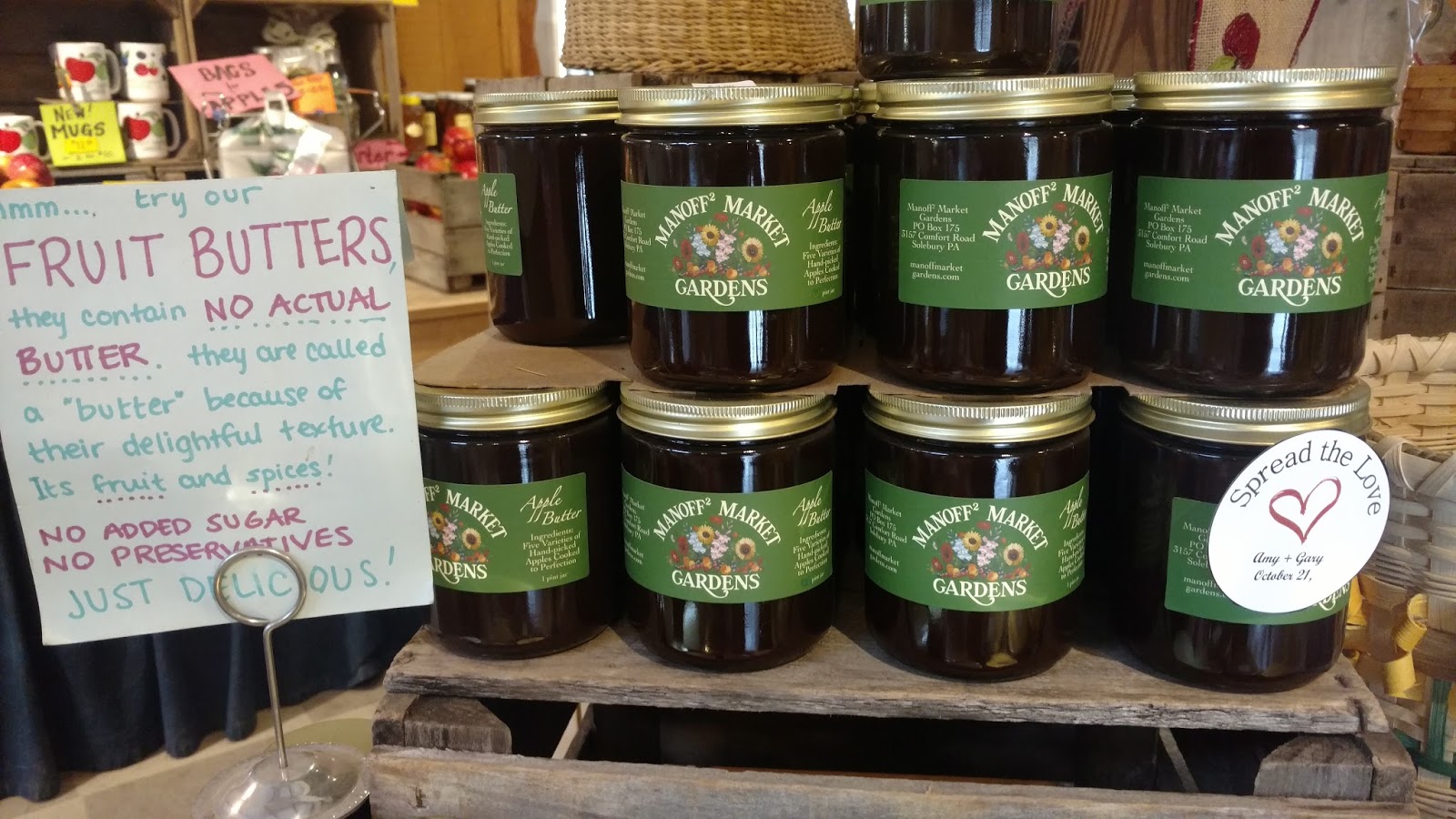
I took a trip last week to Bauman's, a traditional apple butter business run by a husband and wife near Kutztown. We dropped 10 mixed bushels of apples off two weeks prior and received the rich brown butter jarred in return. Apple butter does not contain butter; it is made simply, crushing the apples and cooking them until they are reduced to the consistency of butter. Its tart-sweet flavor lends itself well to a meat marinade or a breakfast topping for toast or oats. I also make my own vegan, gluten-free baked goods and I find that adding a couple tablespoons to my flour and oil mixtures helps combine the baked goods for a better consistency.

After squeezing the truck into a parking space, the processing building takes up a small acre lot in between houses and a narrow lane, I unloaded the boxes into the truck and introduced myself to Mr. Bauman, "Harvey," he said. If it had been a younger person I might have paid and left, but the older generations approve of small talk. The weather was the main subject; spring is variable, the winter was hard, but the crops will pull through, they usually do. Then he asked, "So you're working on the farm, did you go to college?" Tentatively, "Yes," I said, "I went to college for communication and got my masters in development communication. I'm working on the farm, helping with the retail side, but also learning more about the outdoor work involved in the fruit." And with a smile that couldn't lift the corner creases of his hurt eyes Harvey said, "That's nice, my children decided not to continue the family business." Where could I go with that? I think that any family business suffers some degree of hurt when the next generation fails to continue their legacy, but there is a special kind of sadness that I've seen and read about for farmers. Maybe because, for most farmers, work is more than an occupation, it is one's blood and bone, blessing and curse. There's a reason most farmers as they age, look like the land they tend to; like a geologic natural progression, the sun, the earth, the wind and the rain work away at a farmer's solid form. Man starts out fine skinned and pale and ends looking more like an obsidian arrowhead than a polished marble bust, polished through work rather than refinement.  

It's not just farming that's threatened; any skilled trade that takes time to learn is perceived as obsolete. I say perceived, because like the bumper stickers say, "No Farmers, No Food." Not only do we need farmers, and other skilled trades, I would argue that there is a growing trend amongst the younger generations for these products and eagerness to learn these skills. Our reliance on large commercial agriculture owned by a few big names isn't what I mean by farmers. The younger generation in this farming trend doesn't follow the traditional model of taking on their parents work, as it used to be done in the early 1900's, rather they often arrive at this line of work because of personal convictions or exposure through traveling, for example, (WWOOF) World Wide Opportunities on Organic Farms. Popularity and interest in CSA's, Community Supported Agriculture, where one pays a certain amount upfront and gets a fair share of whatever crops the farmer harvests that season, are another way that we can see local resurgence in small-scale farms. Organic is another buzzword that hit the mainstream media and has been taken up by many new young farmers with an interest in integrated often, non-profit driven farming. You can find them at the local farmer's market with their Michael Pollan books, hipster attire and vegetarian inclinations. I kid. But by far, there are less farmers in the United States then there ever have been since it was conquered by our forefather immigrants, not settled as it was land taken by force.  

I can't deny the importance of the work farmers do but the question I wanted to ask Harvey, was, "Is a legacy more important than your kid's happiness?" People tell their kids, you can be anything you want to be, but what most mean is, Do something that makes us look good so we can brag about you, Carry on my legacy because why else have I put in all this effort for if not for your stability? The message is not usually so clear-cut, at least in white suburbia, normally it's disguised in good intentions. Truly, in contrast I picture an image of Buddhist monks, living symbols of non-attachment, and through ritual remind themselves of this non-attachment. For example in their works of sand art, huge mandalas made from painstakingly placed grains of sand laid in whirling precise patterns, which, upon completion, are swept away by the own artisans hands. Why? All that effort for something so beautiful, and they intentionally don't keep it. Then again, monks don't have kids, so this comparison may be unfair.

For me, I feel a physical pain when I am asked this question of carrying on the farm. My parents have spent 30 plus years growing this farm, but I have spent 28 of them here too; I don't have the same skilled knowledge and experience, but the farm has always been a responsibility that I've felt tied to. I can sympathize with both parties, the grown child who feels guilt from parents, and the parents who can't imagine a life on the farm without their children. I see both and the only happy message I can pull from it, is that we all die. HA. We all have a choice to leave our mark in the world whether we choose to pour our efforts into careers, children, charities, but for each and every one of us, that is our choice. Maybe that's optimistic, we don't always have a choice about the things that happen to us, but we have a choice as Bob Marley so wisely wailed, "Emancipate yourself from mental slavery, none but ourselves can free our minds."

Wednesday, March 28, 2018

Education and Regulation


I spent yesterday at a food safety plan writing class that the Penn State Agricultural Extension service workshops for farmers in the area. The Agricultural Extension Service has passed its one-hundredth year of funding from the USDA to educate farmers and conduct research for better agricultural practices.[1] However, their funding for education and research has been shrinking. Near Kutztown, two hours drive along highway 222 puts into perspective the rural nature of Pennsylvania that is still a reality for many. The back roads that twist and branch off among steep hills run perpendicular to a busy four lane highway. The duality of commuting in a rural place with so much traffic is what most New Yorkers traveling to New Hope for the weekend must feel; we are so off the beaten path! Yet, we are only 30 minutes from highway 95.

Entering the conference room, the spectrum of farmers highlighted the range that Agricultural Extension services have to accommodate and prepare for. Two men in their early thirties sat together with their laptops, their clothes too new and their faces too bright, ahhh the educated hipsters that are moving the organic CSA movement, I thought. The man to their left, middle-aged with a jack'o'latern smile and brittle eyes, boasted of his massive pumpkin crop, soon to be exported to Europe; maybe I am too harsh but after the third time of me stretching from sitting and him checking out my breasts, I decided he could play the antagonist role in this column. Adjoining the corner of Mr. Cucurbit, a young Mennonite couple, him, in his staid button-up, jeans, and suspenders, her, in her prairie dress and bonnet. Their behavior affable, but his speech was slow and swallowed, giving me the impression that his biggest worries were about dirt and God; while her speech was clear, concise, business-like. My respect went out to her, without really knowing her. Here was a young woman who probably raised the children, looked after the house, ran the business and still had time to guide her husbands' thoughts on dirt and God.  An old 'salt of the earth' farmer sat beside them; the only one aside from the Mennonites' that mailed in his RSVP instead of emailing and of course they couldn't find his registration. I felt badly, here was a man of an older time, and older generation; I hoped he had a woman beside him at home still, keeping track of important papers and submitting the information to keep up to date with new regulations and audits, but reality can be bleaker than fiction. He was like a lean-to barn in his worn trucker cap and earth crusted clothes, with hands common to old farmers, strong stumps and square fingers dirt caked through the deep wrinkles where even when washed it remains. Beside my mom, Amy, and myself, sat Brett. A familiar face, he apprenticed with my Dad before starting his own farm called Bedminster Orchard selling his diversified produce and value added products like cider and apple butter at farmers markets. For introductions, Brett was first and it says a lot about his self-esteem and maturity for someone in his early twenties to calmly deliver a brief informative introduction to a room of strangers. I, for example, get nervous, stumble and inevitably finish a little more red in the face than when I started. Brett shares an assuredness with many older farmers, a reservoir they draw upon from knowing what they want in life, learning the skills and having the tenacity to stick with it.

All of us, this miniature farmer sample gathered to learn how to comply with USDA Farm Food Safety Plan measures. It was a good review, not just about washing your hands; the speaker shared a lot of insight from his auditing years, about how the details of managing and working a farm fit into the bigger picture of food safety. Each farm is going to have its own unique risks depending upon the type, size and sales model it has, but the themes, of cleanliness, orderliness, logging records, and writing down and educating workers on procedures no matter how obvious they may seem, remain the same. It's about prevention of food borne illness but more so about traceability. About half the farmers in the room used auctions or brokers to move their wholesale produce. All grocery stores require farmers they source from be audited by a third party and subject to one or more of the three food and safety standards. For the other half of us who market directly to customers auditing is voluntary though I believe one of the food and health safety classes is mandatory. The auditing process for us at Manoff Market will be mandatory to get our license to sell our hard cider. However, this class for me is a useful reminder that the record keeping and training and organizing for cleanliness will actually help us in the long run. It will help us to see trends in our business and business practices, help new employees familiarize themselves by making training routine and second nature, and when everything is labeled and has its place and space we become more efficient and some might say sane. Agricultural extension service agents contribute by helping us farmers create better practices in the field, which benefits consumers, as well as providing education and resources for navigating the mire of paperwork that can seem overwhelming to any farming enterprise.  


[1] "The Smith Lever Act formalized extension in 1914, establishing USDA's partnership with land-grant universities to apply research and provide education in agriculture. Congress created the extension system to address exclusively rural, agricultural issues. At that time, more than 50 percent of the U.S. population lived in rural areas, and 30 percent of the workforce was engaged in farming." Accessed 3/28/2018: https://nifa.usda.gov/cooperative-extension-history