Wednesday, March 20, 2019

Tuesday, February 12, 2019
Reimagining positivity from The Depression?
 migrant mother by Dorothea Lange
For my generation, we grew up in an era of excess. The business model for growing food and industry, has been geared towards consumerism. In this business model externalities also known as, the cost of water, energy, and pollution was subsidized in tax breaks to corporations by the government and as a result, hidden from the cost to the consumer. What we are realizing now, through education and a resurgence of sustainable business practices is the understanding that these costs are not external, they are integral as we have limited resources and an environment that needs our help and time to renew itself.
There are exciting new replacements for plastic that are being engineered by students and start-ups in the form of edible packaging made from corn oil, there are foam shipping blocks being made from mycelium, mushroom fungus. Still, plastic is king when it comes to consumerism. Most things we buy are wrapped in plastic, or transported in plastic, which doesn’t biodegrade, and fills landfills. In this transitional period where legislation is slow to ensure environmental sustainability, it comes down to us as consumers. As the ones buying these products for convenience and using single-use plastic for convenience, as individuals how do we take it upon ourselves to life-hack convenient sustainability? As a business how do we make it more convenient for people to re-use?
At the farm a lot of people bring us their plastic bags that we re-use for others. We carry a product by an artisan named Carolyn who makes the Feel-Good Bags by crocheting plastic into reusable totes. We encouraged people to use the baskets and boxes that we sold our fruit in at our store when we gave back a small deposit of fifty cents if they brought them back for re-use. What we found with this though was people weren’t using the same basket over and over again, rather, they were forgetting to bring them back and after the fifth trip or so to our place they might remember and bring back five baskets at once and want a refund. This isn’t a bad thing necessarily but it makes it harder for us to know if the baskets are still clean. For example, I’ve found cat hair in some baskets and after laughing at what must be a cozy space for a cat, threw them away rather than reused these baskets.
Going into this years’ growing season as a business we would eventually like to phase out plastic bags completely but firstly, limit their circulation at our store. The first step is to have more reusable cloth bags for purchase that can be put in the fridge to store and transport the fruit for customers. Secondly, to create greater awareness through signage like “Did you forget your bags in the car?” Because we’ve all done that. For certain fruits like apples, people really want to know which variety they’re eating. Many people will take a separate bag and label each which is really wasteful considering how many varieties we have. A quick fix for those inclined to nomenclature is to give them name labels that they can stick on the fruit. A better way might be to actually educate through an identification sheet of all the varieties with pictures and descriptions which can be handed to people and they can stick on their fridge or, they can take a picture of. We’ve got a lot of ideas but the truth of sustainability depends a lot on individual responsibility. That little bit of effort, that’s hard for us now, because we’re not used to austerity, will eventually become habit. Our conscious choices now, can become good habits that contribute to sustainability in the long run.
Saturday, April 28, 2018
A Quality Drink from Tree to Pint

Gary and Maher planting hard cider specific apple trees

Tractor and auger for drilling the holes for trees
The saying goes, the apple doesn't fall far from the tree, but
what it doesn't say is that those seeds will be completely different apple
trees. We are all similar but different from our parents no?
If you plant an apple seed it has all the genetic variation
of its forebears, meaning, the tree could be any combination of these genetics
and result in an apple quite unlike the tree it came from. To ensure the variety
of tree that we want, farmers use a technique called grafting. This is where
the scion (the desired bud wood) is cut and sealed onto a root stock. The scion
is the trees' mini me, a genetic copy that will grow into the same variety of
apple. The purpose of grafting this scion onto a different root stock (such as
Bud 9) serves two main purposes. Firstly, the root stock is often dwarfing,
which enables the spindle system of growing orchard trees close together.
Secondly, it often has improved disease resistance raising the bar for the
clones' successful establishment. So what's with the Johnny Appleseed folk
character? Why is he spreading seeds?
In Elementary school, I remembered some vague mention of
Johnny Appleseed. Looking back, the nursery-school version left out some
details. John Chapman born 1774, became an orchardist and nurseryman along the
Northeast; establishing apple trees that were used primarily for hard cider and
applejack (distilled apple ferment). Interestingly, orchards were one way to
mark land claims along the frontier at this time. Somewhat of a quirky
character, he was nomadic, religiously pious, but had wealth from his economic
business of establishing and selling hard cider orchards.[1]
The common apples we know today have been selectively bred
for sweetness, texture, and other qualities that appeal to consumers. Traditionally,
Crabapple trees and tart apples were more common. From the Middle Ages (dating
before this too), when lack of fresh clean water led to deaths from dysentery, people
drank hard (alcoholic) cider. Fermentation has always been a way for people to
survive through unfavorable seasons and scarcity. The preservation of food and
drink that enabled perseverance and social bonding became tradition in many
cultures. Britain, where tradition is staunch, still serves local hard cider at
every pub. My parents took a cider tour of Britain, because in their minds, when
they travel, they're still not off the clock. They wanted to get a business sense
of traditional hand-crafted cider. After meeting fellow hard cider farmers who
hosted and shared their knowledge they returned enthusiastic, repeating, "They're
our kind of people!"
The simplicity of cider ferment becomes more of a craft when
you want a replicable taste, smell, and quality to each brew. At home, you can
just add cider yeast and let your cider bubble. If it tastes right, then it's
right and if it's tastes off, then you might have cider vinegar. Here at the
farm, the planning has started. Gary and his crew planted new varieties of
apple trees that are hard cider specific, reaching back to the genetics of
Johnny Appleseed's time, such as, Cox Orange Pippin, Albaramaryle, Arkansas
Black, Newton Pippon, Harrison, Ashmeads Kernel, Yarlington Mill.
Some hard cider varieties we already grow because about half
of our customer base prefers the tart apples for eating and baking. Varieties
such as Gold Rush, Stayman, Winesap, and Crimson Crisp all make good hard
cider. Amy has been putting in weeks of paperwork and research to complete
every step that needs doing for a license to sell hard cider here at the farm.
And Gary has a couple of single vintage varieties brewing, as well as table
blends, spending days, weeks, months, perfecting and tweaking to create a
quality drink from tree to pint.
If you are interested in being the first to sample or learn
about when we launch our product there is a special email list that you can get
onto. Send a message with the subject HARD CIDER, with your interest to
manoffmarketgardens@gmail.com
Thursday, April 12, 2018
Apple butter and the wisdom of Bob Marley
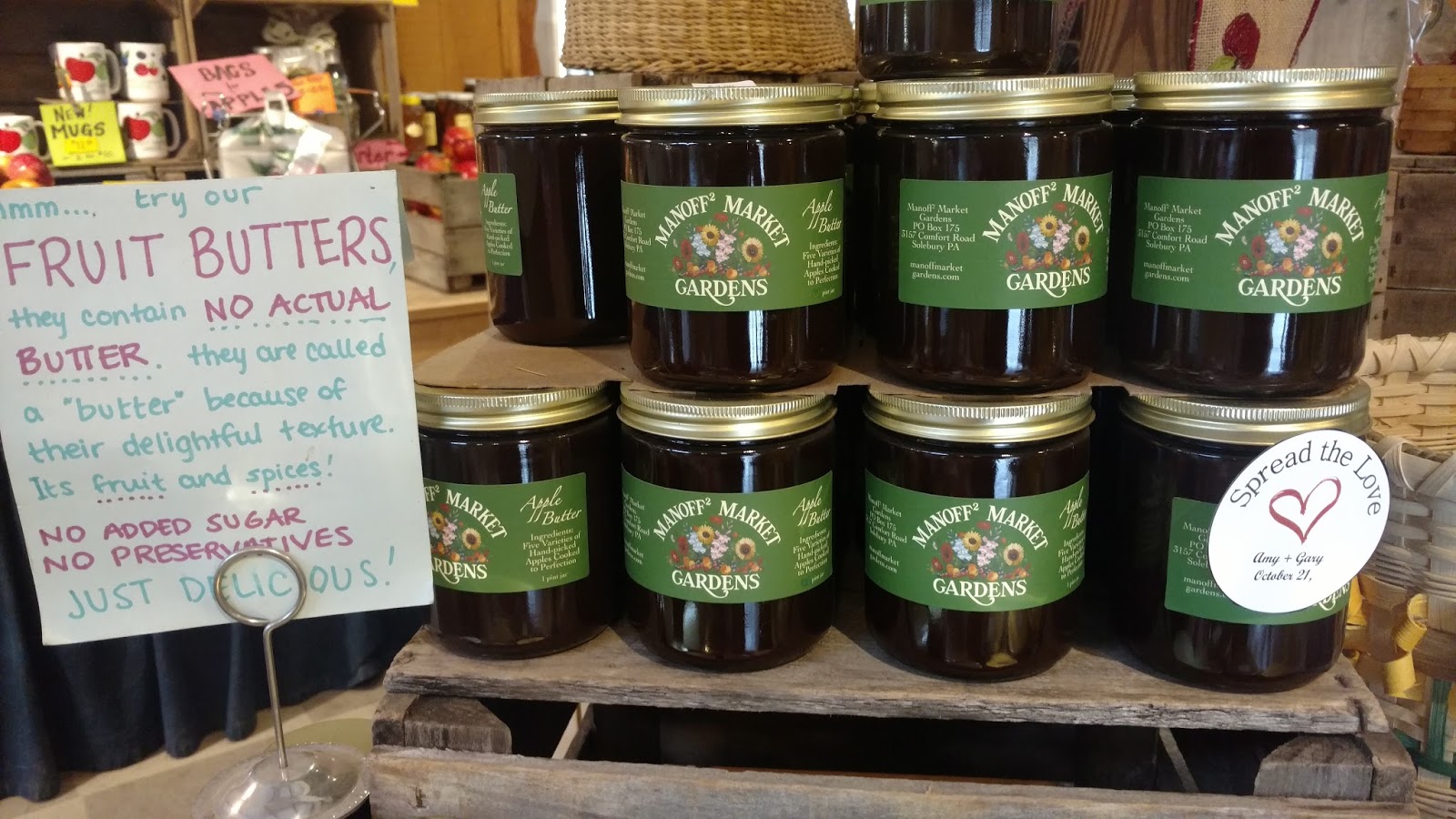
I took a trip last week to Bauman's, a traditional apple butter business run by a husband and wife near Kutztown. We dropped 10 mixed bushels of apples off two weeks prior and received the rich brown butter jarred in return. Apple butter does not contain butter; it is made simply, crushing the apples and cooking them until they are reduced to the consistency of butter. Its tart-sweet flavor lends itself well to a meat marinade or a breakfast topping for toast or oats. I also make my own vegan, gluten-free baked goods and I find that adding a couple tablespoons to my flour and oil mixtures helps combine the baked goods for a better consistency.
After squeezing the truck into a parking space, the
processing building takes up a small acre lot in between houses and a narrow lane,
I unloaded the boxes into the truck and introduced myself to Mr. Bauman,
"Harvey," he said. If it had been a younger person I might have paid
and left, but the older generations approve of small talk. The weather was the
main subject; spring is variable, the winter was hard, but the crops will pull
through, they usually do. Then he asked, "So you're working on the farm,
did you go to college?" Tentatively, "Yes," I said, "I went
to college for communication and got my masters in development communication.
I'm working on the farm, helping with the retail side, but also learning more
about the outdoor work involved in the fruit." And with a smile that
couldn't lift the corner creases of his hurt eyes Harvey said, "That's
nice, my children decided not to continue the family business." Where
could I go with that? I think that any family business suffers some degree of
hurt when the next generation fails to continue their legacy, but there is a
special kind of sadness that I've seen and read about for farmers. Maybe
because, for most farmers, work is more than an occupation, it is one's blood
and bone, blessing and curse. There's a reason most farmers as they age, look
like the land they tend to; like a geologic natural progression, the sun, the earth,
the wind and the rain work away at a farmer's solid form. Man starts out fine
skinned and pale and ends looking more like an obsidian arrowhead than a
polished marble bust, polished through work rather than refinement.
It's not just farming that's threatened; any skilled trade that
takes time to learn is perceived as obsolete. I say perceived, because like the bumper stickers say, "No Farmers,
No Food." Not only do we need farmers, and other skilled trades, I would
argue that there is a growing trend amongst the younger generations for these
products and eagerness to learn these skills. Our reliance on large commercial
agriculture owned by a few big names isn't what I mean by farmers. The younger
generation in this farming trend doesn't follow the traditional model of taking
on their parents work, as it used to be done in the early 1900's, rather they
often arrive at this line of work because of personal convictions or exposure
through traveling, for example, (WWOOF) World Wide Opportunities on Organic
Farms. Popularity and interest in CSA's, Community Supported Agriculture, where
one pays a certain amount upfront and gets a fair share of whatever crops the
farmer harvests that season, are another way that we can see local resurgence
in small-scale farms. Organic is another buzzword that hit the mainstream media
and has been taken up by many new young farmers with an interest in integrated
often, non-profit driven farming. You can find them at the local farmer's
market with their Michael Pollan books, hipster attire and vegetarian inclinations.
I kid. But by far, there are less farmers in the United States then there ever
have been since it was conquered by our forefather immigrants, not settled as
it was land taken by force.
I can't deny the importance of the work farmers do but the
question I wanted to ask Harvey, was, "Is a legacy more important than
your kid's happiness?" People tell their kids, you can be anything you
want to be, but what most mean is, Do something that makes us look good so we
can brag about you, Carry on my legacy because why else have I put in all this
effort for if not for your stability? The message is not usually so clear-cut,
at least in white suburbia, normally it's disguised in good intentions. Truly,
in contrast I picture an image of Buddhist monks, living symbols of non-attachment,
and through ritual remind themselves of this non-attachment. For example in
their works of sand art, huge mandalas made from painstakingly placed grains of
sand laid in whirling precise patterns, which, upon completion, are swept away
by the own artisans hands. Why? All that effort for something so beautiful, and
they intentionally don't keep it. Then again, monks don't have kids, so this
comparison may be unfair.
For me, I feel a physical pain when I am asked this question
of carrying on the farm. My parents have spent 30 plus years growing this farm,
but I have spent 28 of them here too; I don't have the same skilled knowledge
and experience, but the farm has always been a responsibility that I've felt
tied to. I can sympathize with both parties, the grown child who feels guilt
from parents, and the parents who can't imagine a life on the farm without
their children. I see both and the only happy message I can pull from it, is
that we all die. HA. We all have a choice to leave our mark in the world
whether we choose to pour our efforts into careers, children, charities, but
for each and every one of us, that is our choice. Maybe that's optimistic, we
don't always have a choice about the things that happen to us, but we have a
choice as Bob Marley so wisely wailed, "Emancipate yourself from mental slavery, none but ourselves can free our minds."
Wednesday, March 28, 2018
Education and Regulation
I spent yesterday at a food safety plan writing class that
the Penn State Agricultural Extension service workshops for farmers in the
area. The Agricultural Extension Service has passed its one-hundredth year of funding
from the USDA to educate farmers and conduct research for better agricultural
practices.[1]
However, their funding for education and research has been shrinking. Near
Kutztown, two hours drive along highway 222 puts into perspective the rural
nature of Pennsylvania that is still a reality for many. The back roads that twist
and branch off among steep hills run perpendicular to a busy four lane highway.
The duality of commuting in a rural place with so much traffic is what most New
Yorkers traveling to New Hope for the weekend must feel; we are so off the
beaten path! Yet, we are only 30 minutes from highway 95.
Entering the conference room, the spectrum of farmers highlighted
the range that Agricultural Extension services have to accommodate and prepare
for. Two men in their early thirties sat together with their laptops, their
clothes too new and their faces too bright, ahhh the educated hipsters that are
moving the organic CSA movement, I thought. The man to their left, middle-aged with
a jack'o'latern smile and brittle eyes, boasted of his massive pumpkin crop,
soon to be exported to Europe; maybe I am too harsh but after the third time of
me stretching from sitting and him checking out my breasts, I decided he could
play the antagonist role in this column. Adjoining the corner of Mr. Cucurbit, a
young Mennonite couple, him, in his staid button-up, jeans, and suspenders,
her, in her prairie dress and bonnet. Their behavior affable, but his speech
was slow and swallowed, giving me the impression that his biggest worries were about
dirt and God; while her speech was clear, concise, business-like. My respect
went out to her, without really knowing her. Here was a young woman who
probably raised the children, looked after the house, ran the business and
still had time to guide her husbands' thoughts on dirt and God. An old 'salt of the earth' farmer sat beside
them; the only one aside from the Mennonites' that mailed in his RSVP instead
of emailing and of course they couldn't find his registration. I felt badly,
here was a man of an older time, and older generation; I hoped he had a woman
beside him at home still, keeping track of important papers and submitting the
information to keep up to date with new regulations and audits, but reality can
be bleaker than fiction. He was like a lean-to barn in his worn trucker cap and
earth crusted clothes, with hands common to old farmers, strong stumps and
square fingers dirt caked through the deep wrinkles where even when washed it
remains. Beside my mom, Amy, and myself, sat Brett. A familiar face, he
apprenticed with my Dad before starting his own farm called Bedminster Orchard selling
his diversified produce and value added products like cider and apple butter at
farmers markets. For introductions, Brett was first and it says a lot about his
self-esteem and maturity for someone in his early twenties to calmly deliver a
brief informative introduction to a room of strangers. I, for example, get
nervous, stumble and inevitably finish a little more red in the face than when
I started. Brett shares an assuredness with many older farmers, a reservoir
they draw upon from knowing what they want in life, learning the skills and
having the tenacity to stick with it.
All of us, this miniature farmer sample gathered to learn
how to comply with USDA Farm Food Safety Plan measures. It was a good review,
not just about washing your hands; the speaker shared a lot of insight from his
auditing years, about how the details of managing and working a farm fit into
the bigger picture of food safety. Each farm is going to have its own unique risks
depending upon the type, size and sales model it has, but the themes, of
cleanliness, orderliness, logging records, and writing down and educating
workers on procedures no matter how obvious they may seem, remain the same. It's
about prevention of food borne illness but more so about traceability. About
half the farmers in the room used auctions or brokers to move their wholesale
produce. All grocery stores require farmers they source from be audited by a third
party and subject to one or more of the three food and safety standards. For
the other half of us who market directly to customers auditing is voluntary
though I believe one of the food and health safety classes is mandatory. The
auditing process for us at Manoff Market will be mandatory to get our license
to sell our hard cider. However, this class for me is a useful reminder that
the record keeping and training and organizing for cleanliness will actually
help us in the long run. It will help us to see trends in our business and
business practices, help new employees familiarize themselves by making
training routine and second nature, and when everything is labeled and has its
place and space we become more efficient and some might say sane. Agricultural
extension service agents contribute by helping us farmers create better
practices in the field, which benefits consumers, as well as providing
education and resources for navigating the mire of paperwork that can seem
overwhelming to any farming enterprise.
[1]
"The Smith Lever Act formalized extension in 1914,
establishing USDA's partnership with land-grant universities to apply research
and provide education in agriculture. Congress created the extension system to
address exclusively rural, agricultural issues. At that time, more than 50
percent of the U.S. population lived in rural areas, and 30 percent of the
workforce was engaged in farming." Accessed 3/28/2018: https://nifa.usda.gov/cooperative-extension-history
Wednesday, March 14, 2018
Spring and Socialism?
Please note* The following is the opinion of the writer,
Chelsea, and does not necessarily represent the business Manoff Market Gardens.
Easter (the Christian celebration of the resurrection of
Christ),
Passover (the remembrance for the Jewish people of their
liberation from slavery and exodus from Egypt),
Isra and Mi-raj (April 13th this year; the ascension of the
prophet Muhammad when heaven and hell were revealed to him with other
revelations),
With these holy days coming I am reminded of how often our
religions align with the seasons and the corresponding symbolism. Symbolism is
a reflection of reality that shows human desire for nourishment of the soul. For
some, winter is a time of contemplation and hibernation until the busier season
of spring, with the rebirth and relief with which we start a season of planting
and harvesting. The fact that one season flows so seamlessly into another is a
cooperative act between us and nature; one for which I am thankful for when we
have food for every season.
I am always struck by those who go without food, who haven't
had the same privilege to not know hunger. Tomorrow we will be donating bushels
of apples to the local food pantry, Braeburn, of which we have an excess of and
are still crispy and sweet. Here in Bucks County we think we are isolated from
the crippling poverty that is endemic to the United States, because of the stories
that are spun of our successes and the very real successes that we can see in
pockets of wealth here. We are not as isolated as we think; when we think about
who works in our local restaurants serving and doing dishes, who pumps our gas
(in Jersey), who works construction through the winter, who does every other
job that greases the wheels of our leisure and daily necessities. Even with esteemed
professions like teaching, some can barely make ends meet, and yet we blame the
people who "chose" these jobs, that well, it was their choice to be
poor. Then there are those who are elderly, who are on welfare or disability,
who are homeless due to any number of factors:
Factors such as, lack of funding for social services for drug
rehabilitation, veteran rehabilitation and support, and general disinterest in
empowering communities that have been subject to systemic neglect and poverty
because of economic failure, racism, unequal education, inaccessibility to
fresh food or food at all, etc. Social services lack funding however, on a
legislative level, policies could be changed which no longer serve or protect
people, but rather create a cycle of criminal behavior and poverty. For
example, for a person who gets prison time for a misdemeanor which goes on
one's record, he or she consequently can't get a job which creates a cycle
almost impossible to self-alleviate. All
of these contributing factors and more are part of a bigger issue that we have
been unwilling to address in this country. We think that any degree of
socialism will cripple our economy, our society, but if we look at the trajectory
that our country has taken, maybe we should look at socialism as a negotiable
space within our government language. We don't have a problem using socialist
language in our every day interactions with people, in fact, socialist language
can be seen in all religions, "help your brother as you would yourself"
and in this case, your symbolic brother, all men, women etc.
As our society here in the U.S. becomes more and more secular, where is the safety net for those who have none? It's easy to be
critical of privilege, my point is not to judge those who have or have not; my
point is that on a small scale we can do things like donate food, volunteer our
time; but as a people of the United States it would behoove a smarter way of
being in the world to start thinking about how we can correct these issues and prevent
them for future generations. How we act with our privilege and the laws and
money behind policies can affect real change for the have-nots, and
have-some's. I am optimistic, for spring, but also, that the heightened
awareness of issues that face current and coming generations due to the transparency
of knowledge because of the speed, accessibility, and exponential growth of the
internet, will create a catalyst for change. Whether this change will create
better equality, greater opportunity, more resiliency and less hunger, a
rebirth, if you will, we will have to seek and see.
Book List:
On black communities in the U.S. and endemic poverty and empowerment:
James Baldwin The Fire Next Time
(Written in 1963 and tellingly still applicable today). Sister Souljah The Coldest Winter Ever (1999, fictional
perspective but written from experience, really examines empowerment and what
that means with limited opportunities). The
New Jim Crow: Mass Incarceration in the Age of Colorblindness (2012) by
Michelle Alexander.
Information technologies: The Medium is the Message (1967) by Marshall McLuhan. Anything by
Lawrence Lessig, Code: And other laws of
cyberspace (2005), Free Culture (2006).
The Master Switch (2010) by Tim Wu.
Wednesday, February 21, 2018
Pruning 101


For those of you who missed it, the basics:
Have sharp equipment, depending on how tall your tree is, may need a pole saw to reach those top cuts. Large shears.
-First step, renewing cut. This is where you take out the overly large branches that are at the top or near the top of the tree, while leaving a leader branch at the utmost top. The purpose of this step is to keep the tree clear of old thick wood that isn't fruitful. Peach trees should look like a bowl to allow sunlight to filter into the middle of the tree. Apple trees should look like a triangle with larger supporting branches on bottom and thinner fruitful branches leading upward.
-Second step, clearing out the muck, remember, two-year old wood fruits so don't prune too many branches that have buds, and leave some for fruiting next year. The purpose of this step is to make room for you to access and pick the fruit, but mostly, so that sunlight can reach all the fruit on the tree after bloom. This will give you riper fruit with a better blush (color).
Resources:
TREES:
ADAMS COUNTY NURSERY
https://www.acnursery.com/
WAFLER NURSERY
http://www.waflernursery.com/
BOYER NURSERIES
www.boyernurseries.com/
BERRIES:
INDIANA BERRY & PLANT CO.
www.indianaberry.com
NOURSE
http://www.noursefarms.com
PRUNING TOOLS:
OESCO
www.oescoinc.com
BOOKS/GUIDES:
PENN STATE TREE FRUIT PRODUCTION GUIDE
https://extension.psu.edu/tree-fruit-production-guide
TREE FRUIT FIELD GUIDE
TO INSECT, MITE, AND DISEASE PESTS AND NATURAL ENIMIES OD EASTERN NORTH AMERICA
Search for it on Amazon for used copies or
http://palspublishing.cals.cornell.edu
THE APPLE GROWER
By Michael Phillips
Subscribe to:
Posts (Atom)